
Filling Out Your Asset Protection Trust Form
A field-by-field guide
The information you enter on this form becomes the text of your trust. Names print the way you type them. Dates print the way you enter them. Which means the half hour you spend filling this out carefully is the difference between a document that works on the first pass and one that comes back for corrections.
This guide walks through the form in order and explains what each field is asking for, why it matters, and what people most often get wrong. Click here to access the Asset Protection Form after watching the video below or reading through this article.
Two Things to Know Before You Start
“Irrevocable” Does Not Mean “Unchangeable”
The form opens by telling you that an asset protection trust cannot be revoked, and that word makes people hesitate over every decision on the page. It is worth being precise about what it actually means.
Irrevocable means you cannot dissolve the trust and take everything back. That is the specific thing you are giving up, and it is what makes the protection work.
It does not mean your choices are frozen. You retain a power of appointment, exercisable during your life and at your death, which lets you change who ultimately receives the trust property and in what shares. You keep full control over how the assets are invested. So while you should answer thoughtfully, you are not carving today’s answers into stone.
Please Do Not Write “N/A” or “TBA”
This is the most common problem we see, and it is worth understanding why it causes trouble. The answers on this form flow directly into the trust document. A field filled in with “TBA” does not generate a follow-up question — it generates a trust that says TBA.
If you genuinely do not have a piece of information yet, stop and get it before submitting, or contact us and we will help you work through it. A brief pause is far cheaper than a document that has to be redrafted and re-executed.
Gather these before you begin
Your county of residence (the county, not the city).
Your Social Security number.
Full name, address, email, and phone number for the person who will serve as your successor investment trustee.
Full name, address, email, and phone number for your successor distribution trustee — this must be someone other than you, your spouse, or a beneficiary.
The exact legal name of your revocable living trust, including its date, copied directly off the document itself.
The name of the charity or organization you want as your ultimate beneficiary.
Your Information
Title and Suffix
Optional, and both print in your trust. Title is Dr., Mr., Ms., and so on. Suffix is where professional designations go — MD, DO, DDS. If you would rather not use either, leaving them blank is fine. An incorrect one is not.
First Name and Last Name
Use your legal name as it appears on your driver’s license or passport, not the name you go by day to day. If your legal name is Michael and you enter Mike, your trust will be created in the name of a person who does not legally exist — and that becomes a real problem when you go to retitle a bank account into the trust’s name.
Street Address, City, State
Your residential address. Not a P.O. box, and not your office or practice address.
County
The county you live in — and note the instruction on the form not to include the word “county” in your answer. If you enter Clark County, it will read “Clark County County” in your document.
If you are not sure which county you live in, it appears on your property tax bill, or you can search your address along with the words “county assessor.” This is worth getting right: your county appears in the notarization blocks of the executed document.
Use the address you actually check. Every communication about your trust routes here.
Gender
This one surprises people, so here is the reason: the trust document refers to you throughout, and this field determines which pronouns are used. It has no other purpose and no legal significance.
Tax Identification Number (SSN)
Your trust needs its own EIN — a tax identification number separate from your personal one — and we obtain it for you from the IRS. That application requires the Social Security number of the person establishing the trust. That is the only reason we ask.
Enter all nine digits, not just the last four. An incomplete number means the EIN application cannot be filed, which holds up everything downstream.
Are You Going to Have a Co-Trustee?
If you are married, your spouse is the typical choice, but this is genuinely up to you. Naming a co-trustee means both of you serve as investment trustee together, and both of you will sign the documents.
If you answer yes, additional fields will appear asking for your co-trustee’s name, gender, and city and state of residence. Because those fields only appear when they apply to you, there is never a reason to enter “N/A” in them.
Does Your Co-Trustee Have the Same Last Name as You?
Purely mechanical. It controls how the two of you are referred to in the document — whether the trust can use a shared surname or needs to name you separately throughout. Nothing beyond that turns on this answer.
Successor Investment Trustee
This is a real decision, not a formality, and it deserves a few minutes of thought.
Your successor investment trustee is the person who takes over managing the trust assets when you are no longer able to — through resignation, incapacity, or death. Once the original trustors are gone, this person becomes the trustee for everything, including distributions.
How to Choose
Someone financially capable. They will be managing investments, not just signing forms.
Someone likely to outlive you. Naming a contemporary means revisiting this sooner than you would like.
Someone who has agreed to do it. Ask them first. A successor trustee who declines when the time comes creates exactly the gap this appointment was meant to prevent.
Name, Address, Email, and Phone Number
Full legal name. Complete address including zip code. A working email and phone number.
This is the section where “TBA” appears most often, usually because the client has not yet asked the person. That is a fine reason to pause the form and make a phone call. It is not a reason to guess.
Distribution Trustee
The distribution trustee approves distributions to beneficiaries according to the trust’s instructions. This role exists only while an original trustor — you, and your spouse if you have a co-trustee — is still living. After that, your successor investment trustee handles everything.
This is the role that makes the structure work. Because you cannot pay yourself out of the trust without an independent party’s approval, neither can a creditor standing in your shoes.
Who Would You Like to Be the Distribution Trustee?
This field arrives pre-filled with our firm, and most clients leave it as is. You are not required to — but read the requirement on the form carefully, because it is the reason for the default:
At least one of your trustees must be domiciled or based in Nevada.
Nevada’s asset protection statutes are what your trust relies on, and that connection to Nevada has to be real. If you substitute someone else here, that person needs to satisfy the Nevada requirement, or the structure loses the footing it depends on. If you are considering naming someone else, talk to us before you submit.
Address, Email, and Phone Number
If you are leaving our firm as the distribution trustee, use our office information. These fields appear in the trust and in the certificate of trust that you will present to banks and brokerages, so they need to be complete and correct.
Successor Distribution Trustee
This is the hardest field on the form, and it is worth slowing down for.
The successor distribution trustee steps in if the original distribution trustee resigns or can no longer serve. Three rules govern who it can be:
• It must be a specific person or entity. Not our firm again.
• It cannot be you or your spouse. The independence is the entire point.
• It cannot be a beneficiary of the trust. Someone who would approve distributions to themselves is not an independent check.
People stall here searching for the perfect candidate. You do not need one. Reasonable choices include another attorney, your CPA, a trusted professional advisor, or a sibling or friend who is not a beneficiary. If you are unsure whether someone qualifies, ask us — that is a two-minute conversation, and it is much easier than fixing it later.
Living Trust as Beneficiary
This section carries more weight than its size suggests.
You are the beneficiary of the asset protection trust during your lifetime. The question this section answers is what happens afterward. Typically, whatever remains in the asset protection trust when you die pours into your revocable living trust and is distributed according to that document’s terms.
That is why we ask for it. Your asset protection trust is drafted on the assumption that your revocable living trust exists. It is the foundation the rest of the plan sits on.
Do You Have an Existing Revocable Living Trust?
Answer honestly, and be careful about two near-misses. A trust your parents created is not your trust. And a will is not a trust — they do different things.
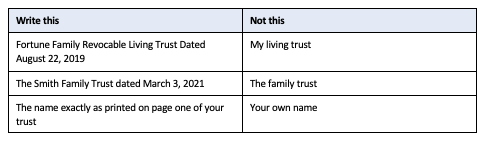
What Is the Full Name of Your Revocable Living Trust?
Two instructions here, and both matter.
Copy it directly off the document. Do not type it from memory. Trust names are long and easy to approximate, and an approximation will not match the trust it is supposed to reference.
Include the date. The date is part of the name. A trust name without its date is incomplete, and if you have amended or restated your trust, the date is what identifies which document we mean.
If you answered “No” to the previous question, enter “None” here — that is the one place on this form where a placeholder is the correct answer.
If You Do Not Have a Revocable Living Trust
You will need one, and it should be drafted by an estate planning attorney licensed in your own state, since it governs property and family matters under the law where you live. If you do not already have someone in mind, avvo.com is one place to find an attorney in your area.
Get in touch with us about sequencing. Depending on your situation, it may make sense to move forward now and add the living trust information once it exists, or to wait until it is in place. That is worth a short conversation rather than a guess.
Ultimate Beneficiary
This is the most frequently skipped field on the form, because it asks you to plan for something remote and unpleasant.
The question is this: if everyone you have named as a beneficiary dies before you do, where should the trust assets go? Without an answer, your trust has no instruction for that scenario, and the outcome gets decided by default legal rules rather than by you.
How to Answer It
Most people name an institution rather than a person — something likely to outlast all of us. A charity, a church or religious organization, a university, an alumni association, a foundation whose work matters to you.
Use the organization’s full legal name rather than how you refer to it in conversation. If you support a local chapter of a national organization, be specific about which one you mean.
What not to enter: “N/A,” your children (they are already covered as beneficiaries, and this field is precisely for the case where they are gone), or an individual person for the same reason.
Before You Submit
The form asks you to review everything for accuracy, and there is a concrete reason. If a name is misspelled here, it will be misspelled in your trust. We catch obvious errors, but we have no way to know the correct spelling of a proper noun we have never seen.
Run through this before you hit submit:
Every name is spelled as it appears on a legal document, not as it sounds.
Your revocable living trust name matches the trust itself exactly, including the date.
Every address is complete, with a zip code.
Your SSN is all nine digits.
Your county is entered without the word “county.”
There is no “N/A” or “TBA” anywhere on the form, and no field you meant to come back to.
When in doubt, ask before you submit.
A question answered before submission takes a few minutes. A correction after the trust is drafted, executed, and notarized takes considerably longer. We would much rather hear from you now.
This guide is general education, not legal advice about your specific situation. Your circumstances may call for choices different from the typical ones described here. If any part of the form raises a question about your own plan, reach out and we’ll talk it through before you submit.